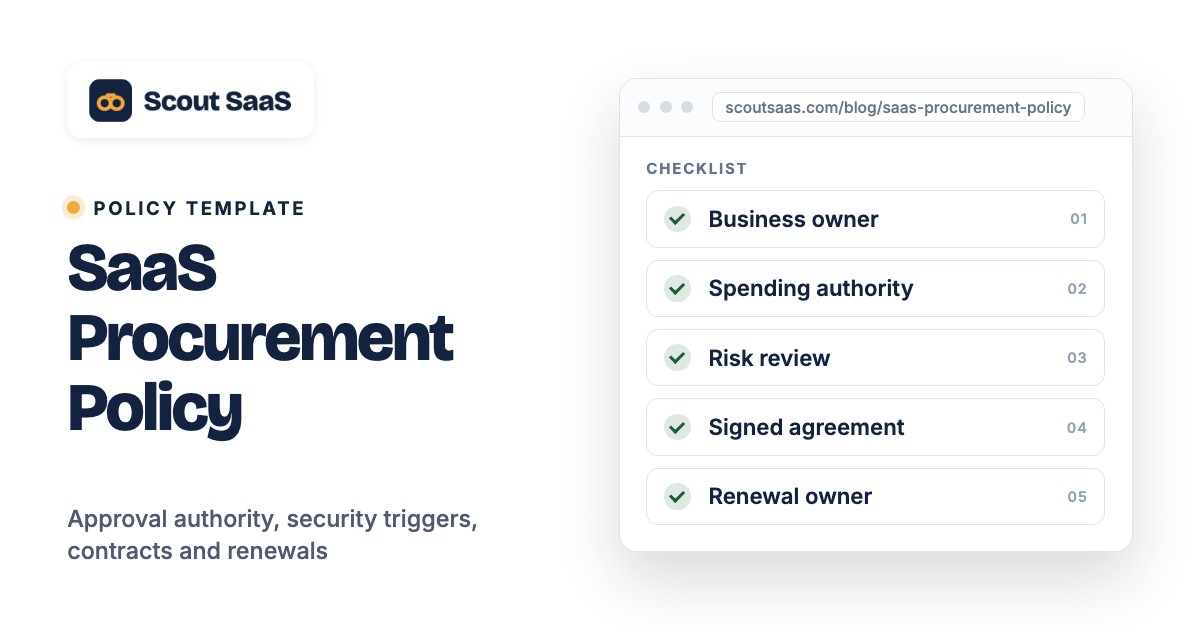
A SaaS procurement policy sets the rules for who can request, evaluate, approve, sign and renew software subscriptions. The policy template below gives procurement, IT, security and finance a practical starting point. It doesn't replace your delegation-of-authority rules or legal advice.
A useful policy isn't a catalog of prohibitions. It's a short set of decisions that people can follow when a new tool appears on a team budget. An employee should know where to submit a request, who reviews it and what proof they must keep before making a commitment.
- Every new paid app needs a named business owner and a recorded request.
- Review the total committed amount, not just the first month's fee.
- Route security review by data and access risk, even for small purchases.
- Only an authorized signatory can accept a software contract.
- Record the notice deadline and renewal owner when the contract is signed.
What's a SaaS procurement policy?
A SaaS procurement policy is the company's written set of rules for acquiring and renewing subscription software. It defines spending authority, risk gates, contracting requirements, exception handling and the evidence that proves approval took place. Unlike a task checklist, a policy's binding inside the organization once leadership's adopted it.
The policy should cover apps bought on company cards, centrally negotiated subscriptions, product-led upgrades, departmental renewals and reimbursed software purchases. An employee shouldn't be able to escape the controls by choosing a different payment method. Free trials deserve attention as well when they require company data or administrator access, even if there's no immediate charge.
Three documents have different jobs. The SaaS procurement pillar defines the buying discipline. The procurement process explains the sequence from request to signature. This policy says which decisions are mandatory, who makes them and what happens when someone needs an exception.
Who should own SaaS purchasing rules?
Finance should own spending authority, procurement or operations should own the purchase record and IT and security should own technology and risk reviews. Legal should own contractual exceptions, though it shouldn't own spending authority. The accountable business owner still has to explain why the company needs the app and what success looks like.
A policy without a named owner won't stay current. Put a person or role in the document header, and don't leave it as a team alias. Give that owner authority to update intake guidance, review exceptions and recommend policy changes to leadership. Their job isn't to approve every purchase personally.
| Decision | Accountable role | Required evidence |
|---|---|---|
| Business need and use case | Requesting department owner | Request and expected outcome |
| Budget and commitment | Finance or delegated budget approver | Cost summary and budget sign-off |
| Technical fit and access | IT owner | Integration and access assessment |
| Data and security risk | Security or delegated reviewer | Risk disposition and mitigations |
| Contract exceptions | Legal | Marked final agreement and exception record |
| Purchase authorization | Named authorized signatory | Signed order or accepted vendor terms |
| Renewal or exit | App business owner | Decision and notice deadline |
Don't confuse consultation with decision rights, because they aren't the same thing. Security may advise on risk, but only the roles in your delegation-of-authority framework can commit company funds or sign an agreement.
Which purchases must go through the policy?
The policy should cover any software commitment that the organization funds or that can expose its data. It isn't limited to formal purchase orders. The first subscription payment and a renewal can create the same kind of ongoing liability.
Include new SaaS tools, incremental seats, premium modules, usage-based upgrades, paid proof-of-concepts, prepaid credits and supplier substitutions. Add free services when employees plan to upload customer information, connect corporate identity or grant access to production systems. Trials with no access to real data can follow a lighter evaluation path.
An exception for genuinely low-risk tools needs explicit boundaries. State its annual spending ceiling, the data classes allowed, whether personal data is prohibited and who keeps the record. Don't let teams split one purchase into smaller orders to avoid the approval matrix.
What information belongs in a software request?
A software purchase request should contain enough information to route decisions without another long email thread. Start with the problem, owner, users, cost and data access. More complex intake fields should appear only when risk triggers them.
- Requester, department and named business owner
- Business problem, intended outcome and expected users
- Product name and alternatives already considered
- Requested start date and deadline for a decision
- Pricing proposal, billing cycle and full commitment period
- Budget code, payment method and requested signatory
- Data classification and types of information involved
- Required integrations, SSO and administrator permissions
- Contract end date, auto-renewal clause and notice period if available
- Implementation owner and person accountable for offboarding
If a team requests a product with access to customer data, don't approve it because the price's small. A low-dollar subscription can still create a meaningful privacy, operational or security obligation. Require the requester to name the data it'll handle.
How should SaaS approval thresholds work?
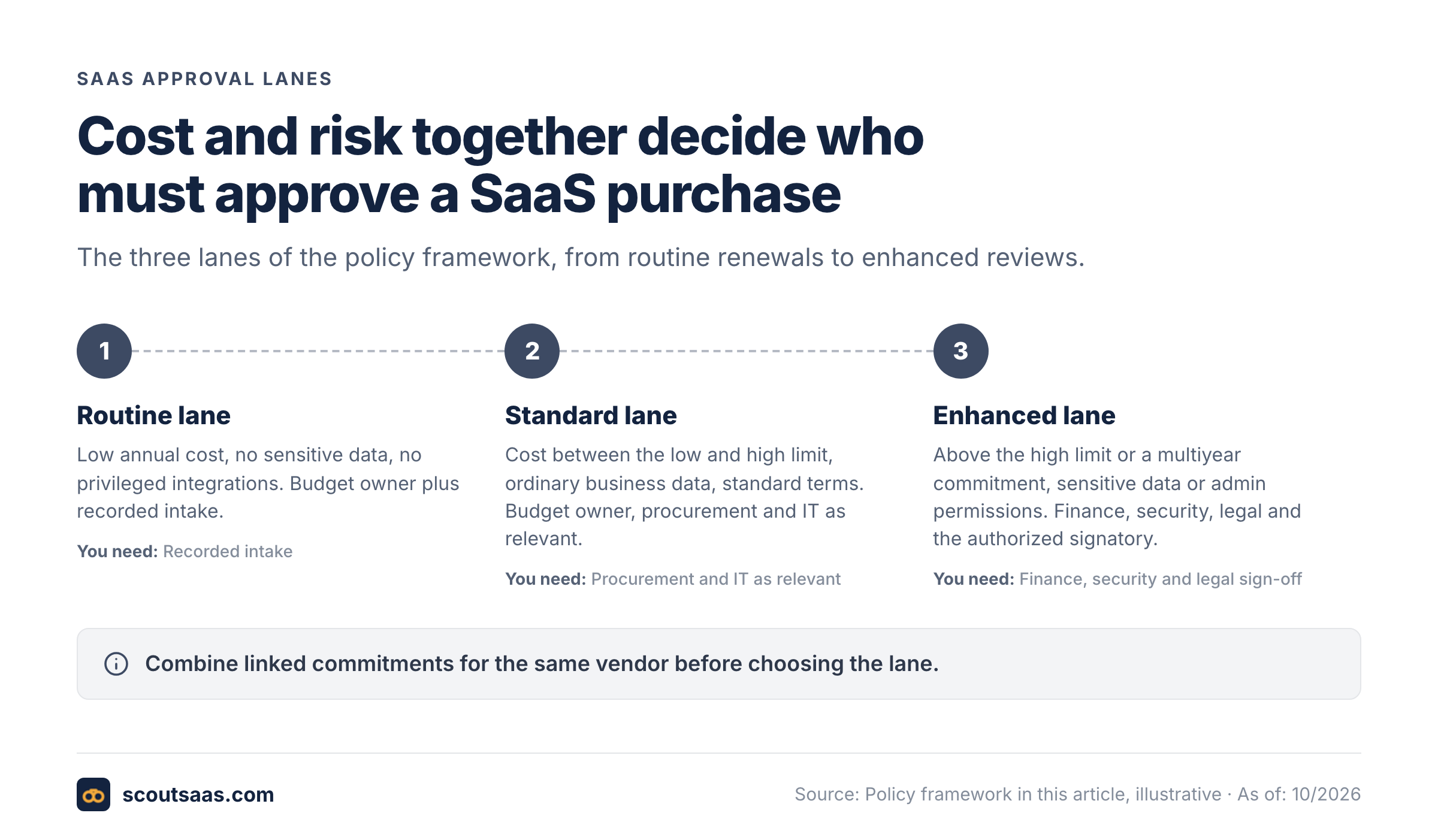
SaaS approval thresholds should use the company's existing financial delegation, combined with separate triggers for data, technical and contract risk. The examples here are a design framework, not industry-standard spending limits. Finance must fill the actual dollar bands before adoption.
| Policy lane | Cost criterion | Risk criterion | Approval path |
|---|---|---|---|
| Routine | At or below [LOW_ANNUAL_LIMIT] | No sensitive data, no privileged integrations | Budget owner plus recorded intake |
| Standard | Above low limit and up to [HIGH_ANNUAL_LIMIT] | Ordinary business data and standard terms | Budget owner, procurement and IT as relevant |
| Enhanced | Above high limit or multiyear commitment | Sensitive data, admin permissions, material exception or unusual renewal | Finance, security, legal and authorized signatory as triggered |
The contract value should include the committed period, required setup, minimum seats, prepayment, noncancelable modules and any mandatory service charges. A vendor's monthly display isn't necessarily the amount the business owes. Record optional future consumption separately so reviewers can distinguish a binding commitment from a possible overage.
Consider a hypothetical subscription with 18 seats at $40 per seat each month, a one-year minimum and a $1,500 required onboarding fee. The first-year committed value is 18 × $40 × 12 + $1,500 = $10,140. That's a worked policy example, not a published market price. If finance reviews only the $720 monthly subscription line, the approval may use the wrong authority band.
The approval workflow shouldn't send every purchase to the CEO. It should route the right approvers by threshold and risk, then give them a time limit. Record any delegation, including what happens when an approver is out of office.
When does security or privacy review become mandatory?
Security or privacy review becomes mandatory when the supplier will process sensitive data, connect to privileged systems or create a material dependency. A low-cost browser extension with broad permissions may need more scrutiny than a higher-cost tool that only handles public marketing assets.
Use three practical screening questions: what data can the vendor access, what permissions will its integrations receive and what would happen if the service fails or discloses information? A requester doesn't need to be a security expert to answer these questions at intake. The specialized reviewer should decide the controls and evidence needed.
NIST's Cybersecurity Framework 2.0 C-SCRM guide describes communicating supplier requirements through procurement and supply-chain risk management. Its guidance is a source for designing your review path, but it's not a certification that any particular SaaS vendor's safe.
For a high-risk vendor, ask for an applicable data processing agreement, a current security assurance report, subprocessor details, incident notice terms, access controls, recovery arrangements, a deletion process and relevant data-location facts. The Cloud Security Alliance CAIQ Lite is one structured source for cloud assessment questions. Don't demand a lengthy questionnaire for every low-risk design subscription.
How should risk bands change the review?
Risk bands should change the depth of evidence, not remove accountability. A routine purchase might use an attestation that no confidential data is involved and that access is limited. A standard review may require security and privacy documents. An enhanced review may require a technical meeting, contract changes and a written acceptance of residual risk.
A certification badge shouldn't end the assessment. Confirm the report's scope, date and covered product. Where data processing or integrations differ from the certified service, document the gap. A reviewer should record an accept, remediate, reject or exception decision with the actual rationale.
What should finance, legal and IT check before signature?
Finance should validate affordability and contractual commitment, legal should review material terms and IT should confirm the onboarding and exit path. These roles don't have to work sequentially when the evidence's ready. They do need a shared final agreement.
Finance: check budget holder, cost center, minimum seat commitments, billing currency, prepayment, variable usage, tax treatment and whether the vendor's quote matches the approval request. Pay special attention to annual commitments disguised as monthly list prices.
Legal: check contract term, governing law, limitation of liability, confidentiality, data processing, renewal clauses, termination rights, data return and deletion. Review click-through terms as well as negotiated order forms. A requester who clicks "accept" on a binding order may have created obligations without signature authority.
IT: confirm approved identity methods, least-privilege integration scopes, ownership of the vendor admin account, onboarding responsibilities, employee offboarding and data export. Ask who can disable access if the sponsor leaves the company. If the product's critical, plan for outages and supplier exit rather than treating migration as a future problem.
The final approver should see one decision record linking the signed terms, cost assumptions and all required reviews. Screenshots of a chat approval don't replace a signed order or an authorized electronic acceptance.
How do you write an exception policy that won't become a loophole?
A procurement exception should identify the exact control being waived, the reason, the person accepting the residual risk, the mitigation and the date it expires. It isn't permission to ignore the rest of the purchase process. Emergency access should use a faster path with later review rather than a permanent bypass.
The request should be visible to procurement and the relevant control owner. For instance, a department may need an urgent vendor before a full assessment is complete. Security can permit limited test data and restricted access for a fixed interval while the formal review continues. The approved scope, expiry and follow-up owner should be written down.
Check exceptions quarterly, since they'll show where the policy doesn't fit. If teams repeatedly ask to waive the same approval, the policy might be impractical, but the intake process could also be too slow or the intake process too slow. A good rule should protect the business without creating incentives to hide purchases.
What happens when a SaaS contract renews?
The SaaS renewal decision should return to the policy when the commitment, supplier risk or scope changes. Record the renewal owner at purchase rather than discovering an auto-renewal clause after the notice date's passed.
At a minimum, capture contract start, end, renewal date, termination notice and escalation owner. Send reminders early enough for usage review, alternative quotes, security reassessment if needed and legal notice. A business owner should document renew, rightsize, replace or cancel. The policy shouldn't treat silence as a positive purchasing decision.
For a product with a 60-day notice period, use an earlier internal review date that leaves time to gather evidence and secure sign-off. The actual reminder interval's an operational choice, though notice periods still set the outer limit. Don't describe it as a universal legal requirement, since it isn't one.
How do you implement this policy without slowing teams down?
Implement the policy by piloting a small number of distinct real-world request types before applying it companywide. The following rollout is an illustrative four-week plan, not a promise that every company's legal and security setup can be completed in a month.
- Finance and procurementMap existing signing authority and define purchase scope Week 1
- IT and securityAgree on risk triggers and the evidence required by lane Week 2
- Procurement and department ownersPilot a simple request and a sensitive-data request Week 3
- Policy ownerPublish the approved policy, train requesters and set review cadence Week 4
In the first pilot, use a routine subscription that has no sensitive integration. In the second, use a vendor that will process customer information. Track the time lost waiting for missing details. If the requester can't tell which forms are required, simplify the intake.
A third scenario should test a renewal with a short notice period. The goal isn't to automate everything at once, but it's worth learning which decision points need a default approver. It's to learn which decision points need a default approver, an escalation rule or a preapproved standard.
Software can coordinate requests, quotes and approval histories after the policy's clear. A tool like the SaaS procurement software directory can help teams compare workflow options. It doesn't decide your company's authority thresholds on your behalf.
SaaS procurement policy template: copy and adapt
A practical SaaS procurement policy template should include the specific rules that an approver can enforce. Copy the sections below into a company document, replace the bracketed fields and obtain internal approval before treating the result as binding policy.
1. Document control
Policy title: SaaS Procurement and Subscription Purchasing Policy. Owner: [ROLE]. Approved by: [APPROVAL BODY]. Effective date: [DATE]. Next review: [DATE]. Version: [NUMBER].
2. Purpose and scope
The company requires all paid SaaS purchases, subscription renewals, upgrades and reimbursed software to follow this policy. Free tools are also in scope when they access nonpublic company data, customer data or privileged systems. Exceptions must follow Section 10.
3. Request and ownership
Before purchase, the requester must submit [INTAKE LOCATION] with the business case, intended users, business owner, full commitment value, budget code, data classification and proposed vendor. Each approved tool must have a named application owner and renewal owner.
4. Approval authority
Purchases with total committed value up to [LOW_ANNUAL_LIMIT] require [LOW_APPROVER]. Purchases above that amount up to [HIGH_ANNUAL_LIMIT] require [STANDARD_APPROVERS]. Purchases above the high limit, or with elevated risk, require [ENHANCED_APPROVERS]. Signing authority is governed by [DELEGATION_OF_AUTHORITY_DOCUMENT]. Splitting purchases to evade thresholds is prohibited.
5. Information security and privacy
A purchase requires security review when it handles [SENSITIVE_DATA_CLASSES], requires privileged access or meets [OTHER_RISK_TRIGGERS]. Privacy review is required where [PRIVACY_TRIGGER]. No production data may be uploaded before required reviews and contract terms are complete.
6. Vendor evaluation and documentation
Procurement records reasonable alternatives, the selection rationale, material vendor security documents and the approved pricing. Review depth depends on risk and value. Any waived sourcing requirement requires a documented exception.
7. Contracting and acceptance
Only [AUTHORIZED_ROLES] may sign or electronically accept binding vendor terms. Legal reviews [LEGAL_REVIEW_TRIGGERS]. The purchase record must include the final order form, applicable DPA, contractual term, cancellation procedure and approved total commitment.
8. Inventory, access and renewals
The application owner records subscription owner, users, billing cadence, contract dates, notice period and key integration permissions in [SYSTEM_OF_RECORD]. Before renewal, the owner documents continuing value and whether to retain, reduce or cancel the service.
9. Records and retention
The company stores intake, reviews, approvals, exceptions and final signed agreements in [EVIDENCE_LOCATION] for [RETENTION_PERIOD], subject to legal holds and applicable privacy requirements. Access is limited to authorized roles.
10. Exceptions and violations
An exception requires [EXCEPTION_APPROVER], written justification, mitigating control and expiry. Urgent requests use [EXPEDITED_PROCESS] with subsequent review by [DEADLINE]. Unapproved purchases may be suspended or escalated under [ENFORCEMENT_POLICY].
11. Review and change control
The policy owner reviews this policy every [CADENCE] or after material changes in business risk or purchasing operations. Material amendments require [APPROVAL BODY]. Teams receive the revised policy through [COMMUNICATION_CHANNEL].
How should procurement measure whether the policy works?
Procurement policy performance should be measured through process outcomes, not the number of forms completed. Track how long a complete request waits for a decision and how often a request's sent back because its scope or cost's unclear.
Useful operating measures include intake completeness, median approval time by risk lane, share of purchases with a named owner, renewals reviewed before notice deadlines, exceptions that expire on time and spend with unknown application owners. Define the numerator and denominator before reporting. A small company shouldn't pretend that every metric requires a complex analytics platform.
Use the data to refine the policy, and don't treat it as a scorecard for requesters. Repeated bypasses may point to unclear communication, though they can also mean the process is too slow. But a growing backlog of security reviews may mean low-risk requests need a lighter standard. Don't trade away meaningful controls just to make the median time look good.
What mistakes make SaaS procurement policies fail?
SaaS procurement policies fail when they're vague about authority, risk or where to start. A rule that says "get IT approval" doesn't tell an employee whether purchasing is allowed before security review or whether IT can commit funds.
Another common failure is reviewing price but not contract terms. A modest monthly seat cost may become a much larger noncancelable annual commitment. Some purchases also receive complete reviews at the start but have no owner assigned to the renewal.
Finally, beware policies that mandate a full security questionnaire for every purchase. They can increase shadow purchasing when employees can't get timely decisions. Set clear risk triggers and create a fast path for low-risk spend. That keeps the core control credible.
SaaS procurement policy FAQs
SaaS procurement policies work best when finance, legal, IT and requesters use the same definitions. These answers clarify common edge cases.
Do free SaaS tools need procurement approval?
Free SaaS tools can need review when they access confidential or personal information, use company identity or connect to privileged systems. Payment amount alone isn't a sufficient risk test.
Who should sign a SaaS contract?
A SaaS contract should be signed only by a person with authority under the company's delegation policy. Budget approval doesn't automatically grant legal signature authority.
Should every SaaS renewal require new approval?
A SaaS renewal should be reviewed before the notice deadline. The company can use a lighter confirmation when price, scope and risk remain unchanged under its documented rules.
What is the difference between a procurement policy and checklist?
The procurement policy defines binding rules, owners and exceptions. A procurement checklist helps employees gather evidence and finish tasks under those rules.
Can employees buy software on a corporate card without procurement?
Corporate card purchases should stay inside the policy. A company may preapprove a narrow low-risk spending lane, but the requester still needs an owner and purchase record.
How often should the policy be reviewed?
The policy owner should set an organization-specific review cadence and also revisit the rules after material changes to systems, regulations or approval authority.
A successful SaaS procurement policy makes the next purchase decision easier to defend. It gives employees a clear entry point, protects data according to risk and puts a person in charge of every agreement and renewal. Start with the template, run a few real requests and revise what doesn't work.